Why 125 years matters
From a rented room on Chestnut Street.
Founded in 1901 by Greek immigrants who arrived with little more than their faith, ours was the sixth Greek Orthodox parish established in America and the first in the Philadelphia region.
From a rented room on Chestnut Street, to a converted church on South Twelfth Street, to the sanctuary that rises today in Elkins Park, it has served the Delaware Valley without interruption for a century and a quarter, and from which twelve sister parishes evolved. Every Orthodox Christian in the greater Philadelphia area can trace the roots of their faith back to Annunciation – Evangelismos, now in Elkins Park. In fact, Saint Demetrios of Upper Darby began as our own satellite.
The parish is bound in one further way to the wider Church and the Ecumenical Patriarchate. Of the sixty years since the Archons of the Ecumenical Patriarchate were founded in 1966 in the Greek Orthodox Archdiocese of America, National Commanders drawn from this parish have led for forty-one of them. Read more about our parish's Archons →
Every building this community has occupied was paid for by people who gave from modest wages so that an altar, an icon, or a set of doors might be set in place.
-
1901
814 Chestnut Street, fourth floor
Archimandrite Nathaniel Sideris gathers scattered immigrants who had been bringing priests down from New York. They rent a floor, arrange it for Orthodox worship, and celebrate the first Divine Liturgy. Demetrios Diamantopoulos chairs the first Church Council.
-
1905
247 South Sixth Street
The community outgrows the rented floor within four years.
-
1908
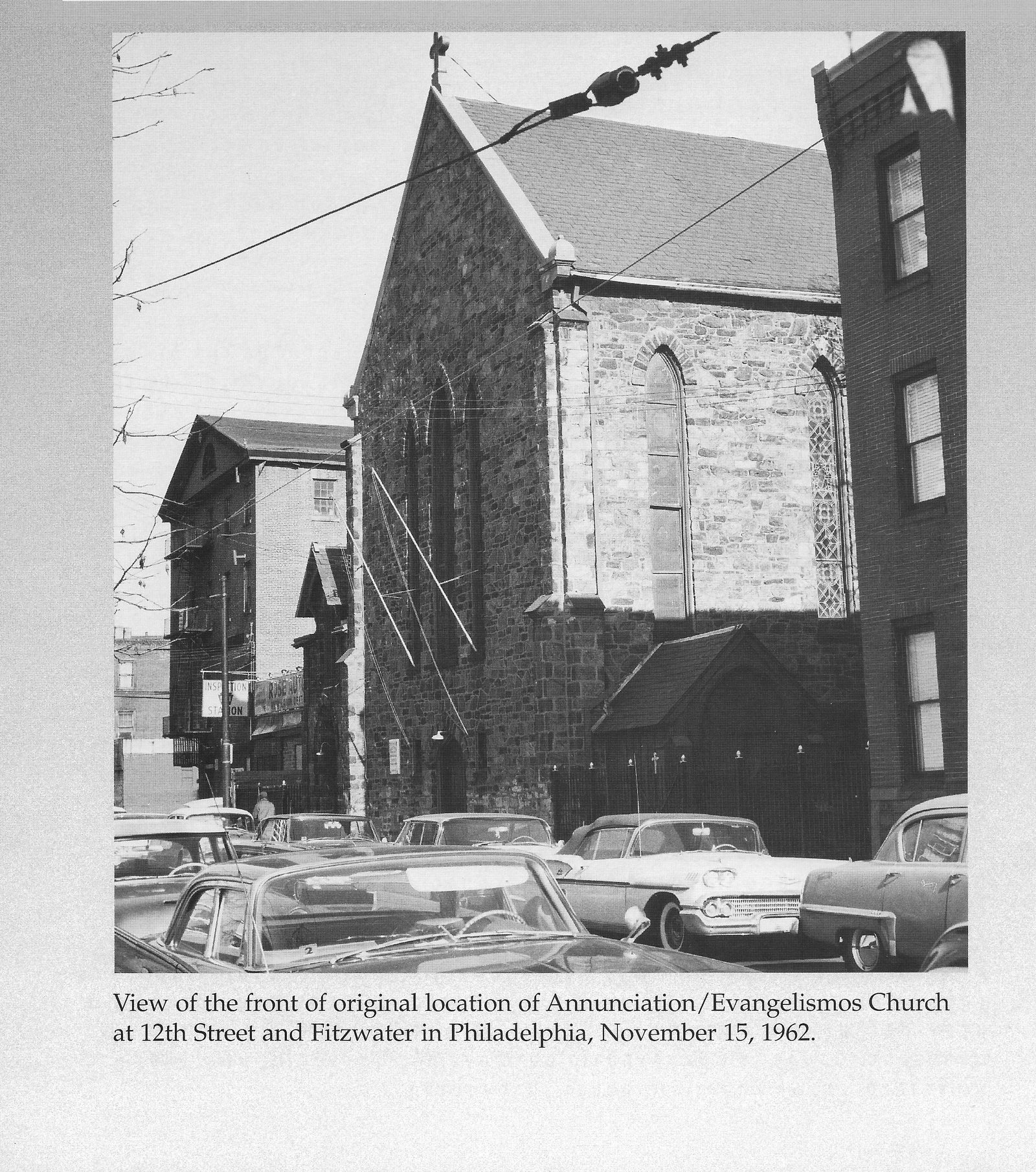
745 South Twelfth Street — “Old Evangelismos”
An Episcopal church is purchased for $35,000 and converted, at roughly the same cost again, into the Church of the Annunciation. It serves as the spiritual and cultural center of Greek Orthodox Philadelphia for more than sixty years.
-
1907–1916
Father Raphael Morgan
A convert from Jamaica, ordained at the Ecumenical Patriarchate, serves this parish as the first Black Orthodox priest in America.
-
1963
Elkins Park
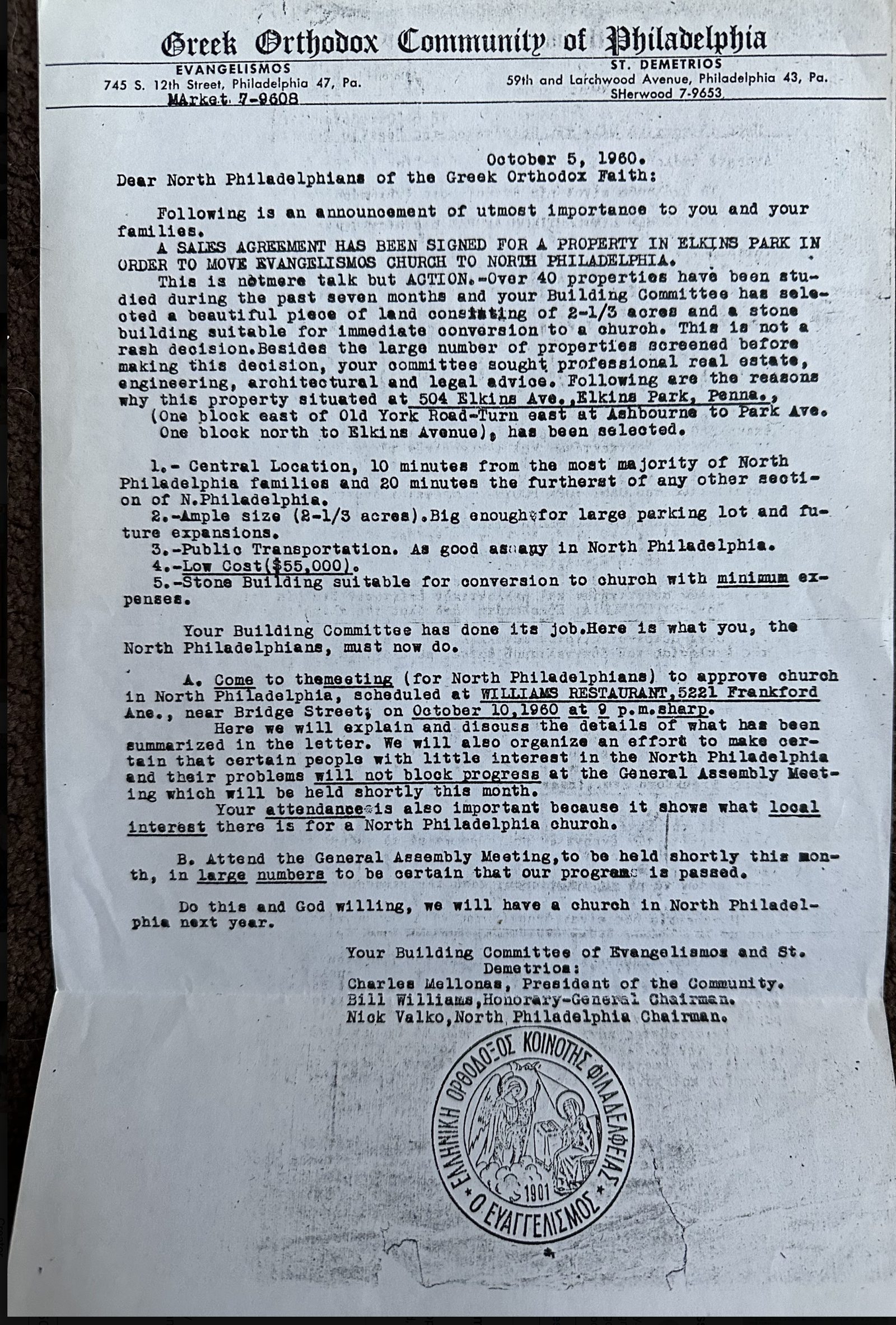
A general assembly votes to follow the parishioners into the suburbs. Saint Demetrios becomes its own parish in Upper Darby; Evangelismos moves north to a site next to the Constantine Stephano estate on Elkins Avenue, a few blocks from where the parish stands today.
-
1968–1972
The present complex
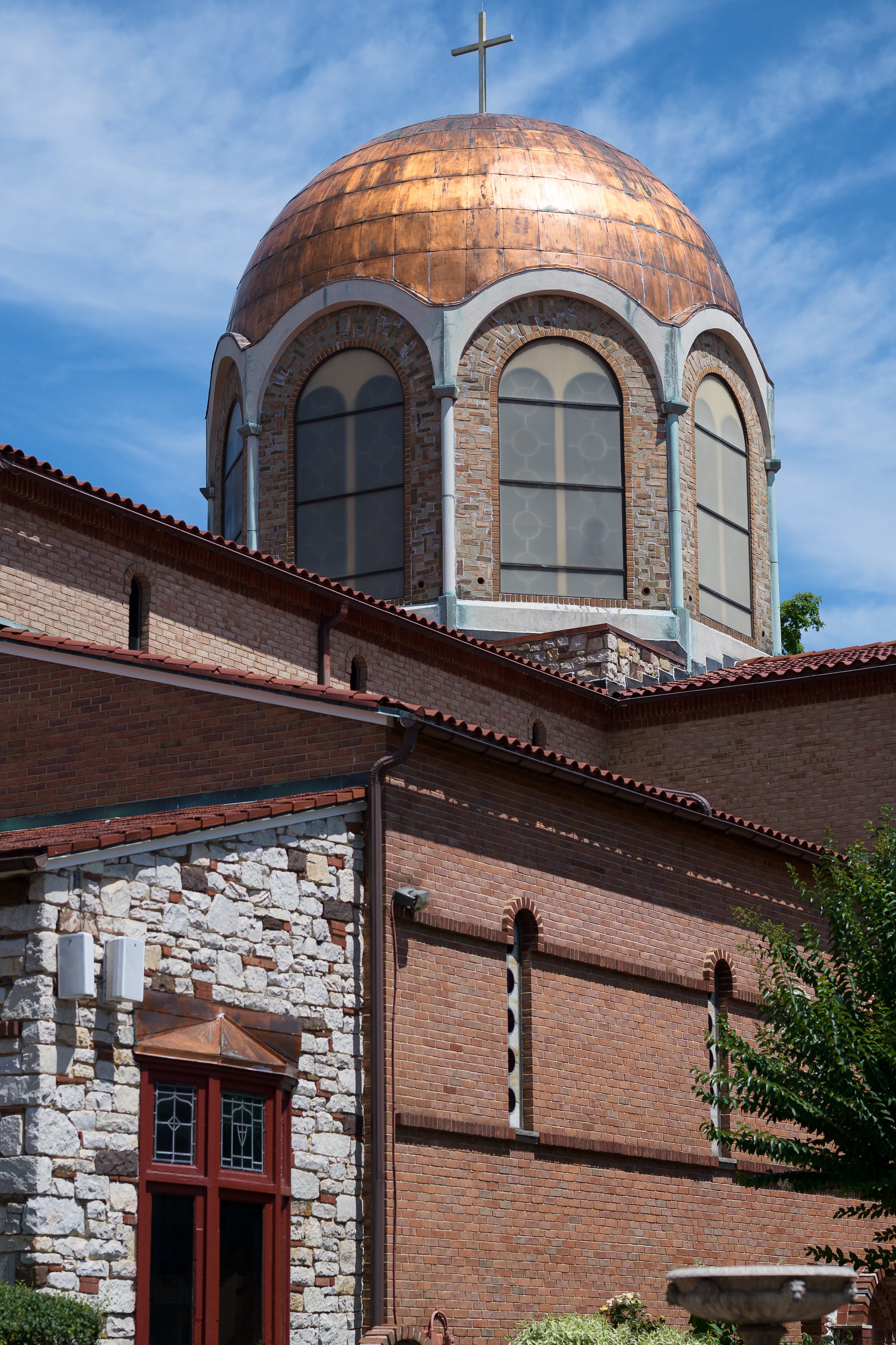
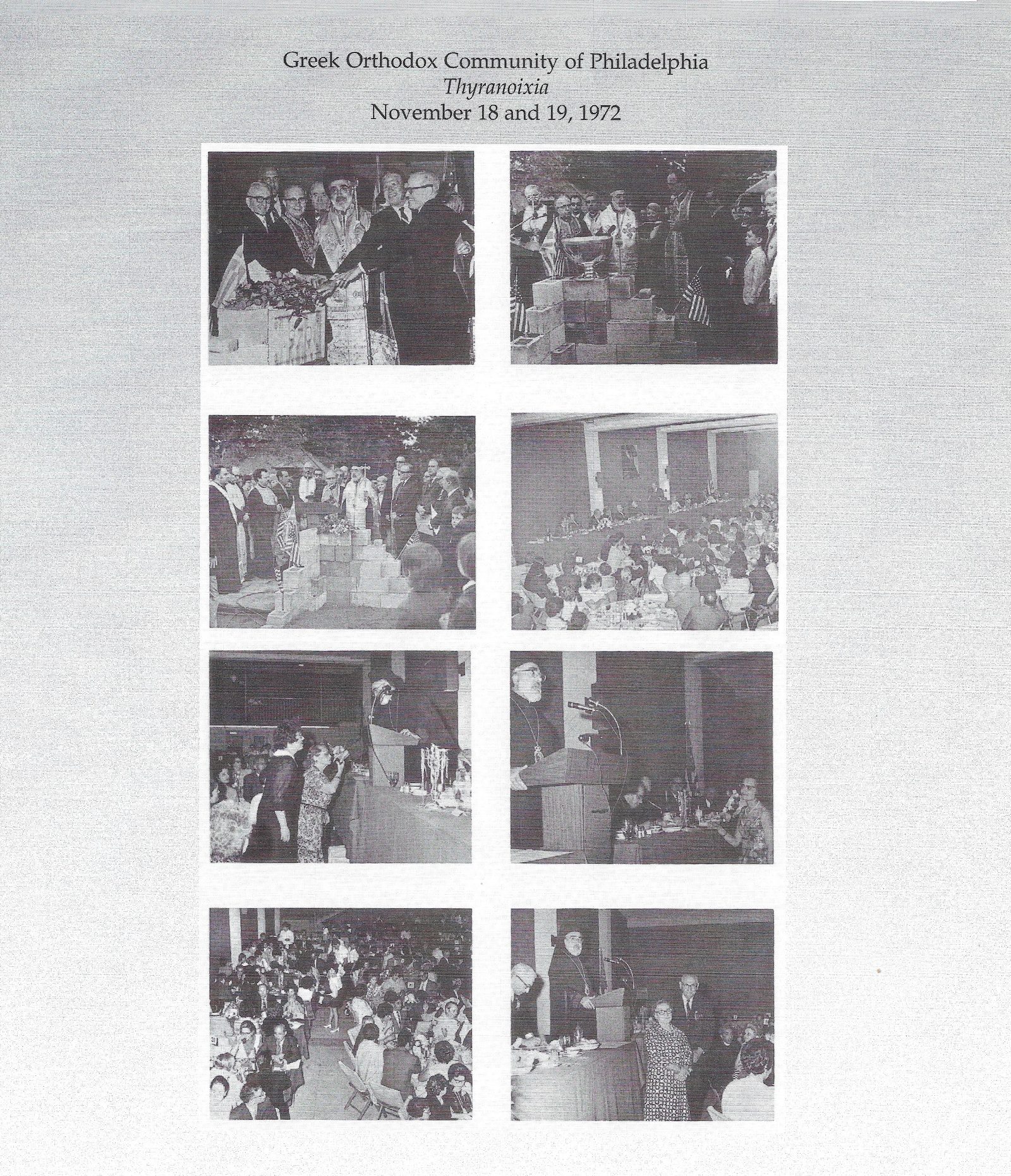
Construction begins on the Hellenic Cultural Center in June 1968, followed by the Church Edifice, led by Fr. John A. Limberakis and Dr. Anthony G. B. Borden. The church opens for worship on November 19, 1972 — a single copper dome rising over the sanctuary in the Byzantine style of Ravenna, alongside a fellowship hall, a dozen classrooms, and a library. George and Lopi Pavlis unlock the doors at the Thyranoixia — the “opening of the doors” service — conducted by the legendary Archbishop Iakovos of North and South America.
The design was entrusted to Demetrios Siderakis of New York, a Byzantinologist educated in Athens and at Columbia, working with local architect Alfred Olexy; Luckens Construction Company of North Wales built it, supervised pro bono by parishioner Themis C. Pailas. Nicholas Ikaris crafted the religious artifacts, George Filippakis and George Gleatas painted the iconography, and the marble altar, baptistery, and columns were imported from Greece.
-
2001
Consecration
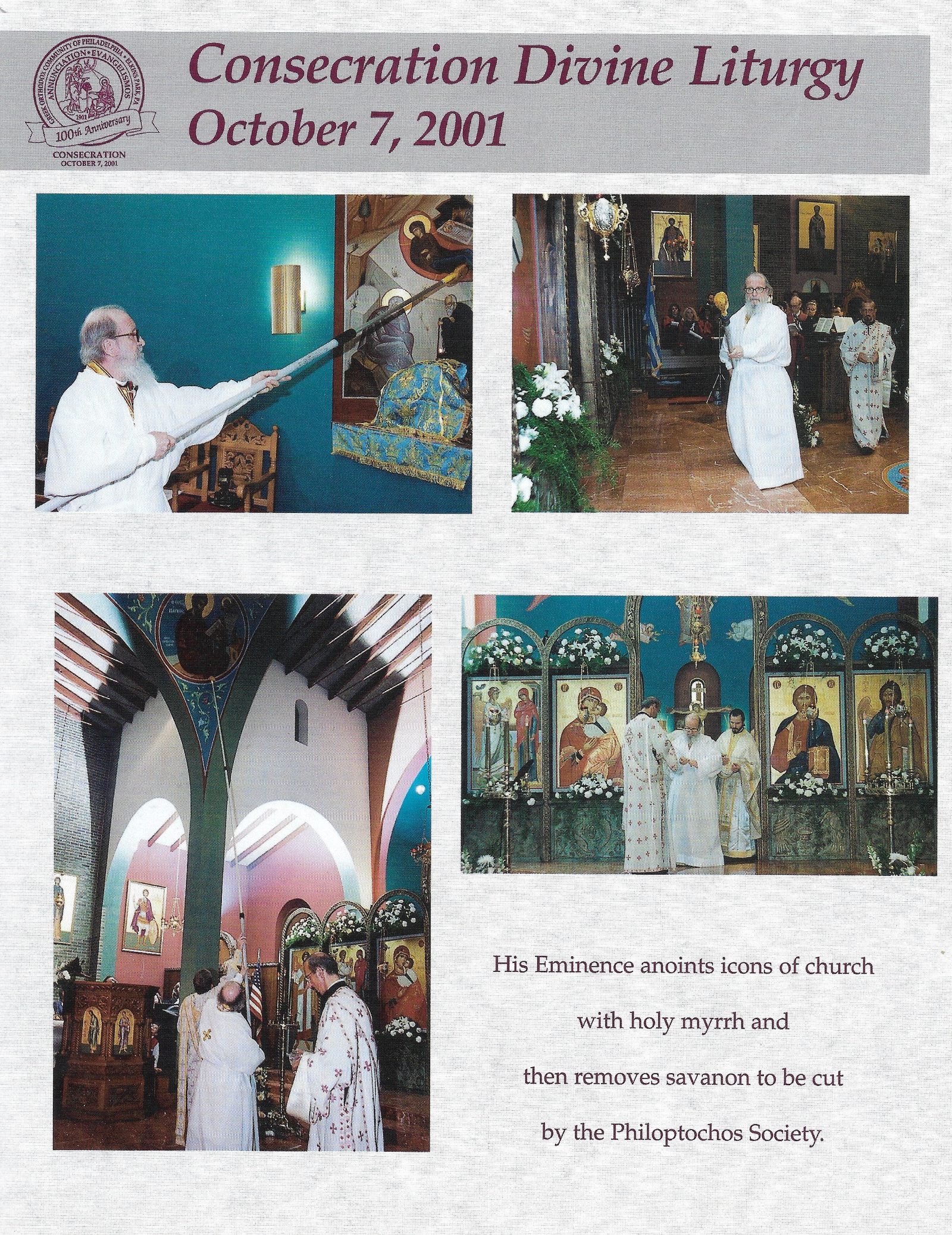
Archbishop Demetrios of America consecrates the church on October 6 and 7, coinciding with the community's centennial observance.
Most fitting during this milestone: Mrs. Lillian H. Borden, the widow of Dr. Borden, served as Parish Council President at the time and coordinated the consecration of the church he had promised the Panagia he would build, after he was nearly killed in World War II defending his native Greece from the Nazis.
-
2025
Phase One
The classrooms, church offices, and upstairs bathrooms are completely renovated, with a new main entrance to the education wing and a new kitchen entranceway — demolition to dedication in about fourteen weeks, financed by a bank loan the parish is still retiring. Faith, determination, and commitment carried it, the same three words that carried every building this community has raised before it.
-
2026
One hundred twenty-five years
The anniversary is marked at the Crystal Tea Room on October 10. The campaign is the part that outlasts the evening.
Two names above all others
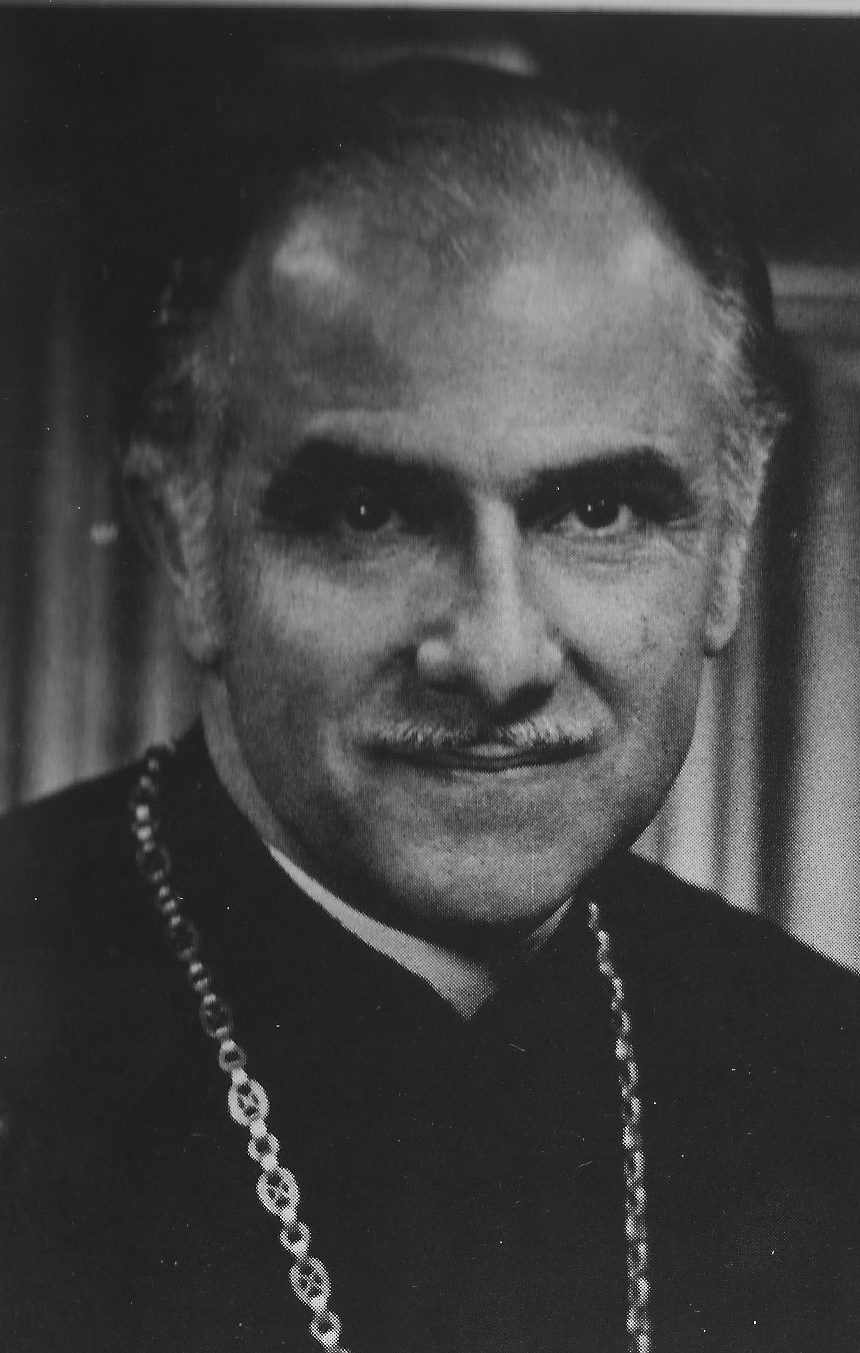
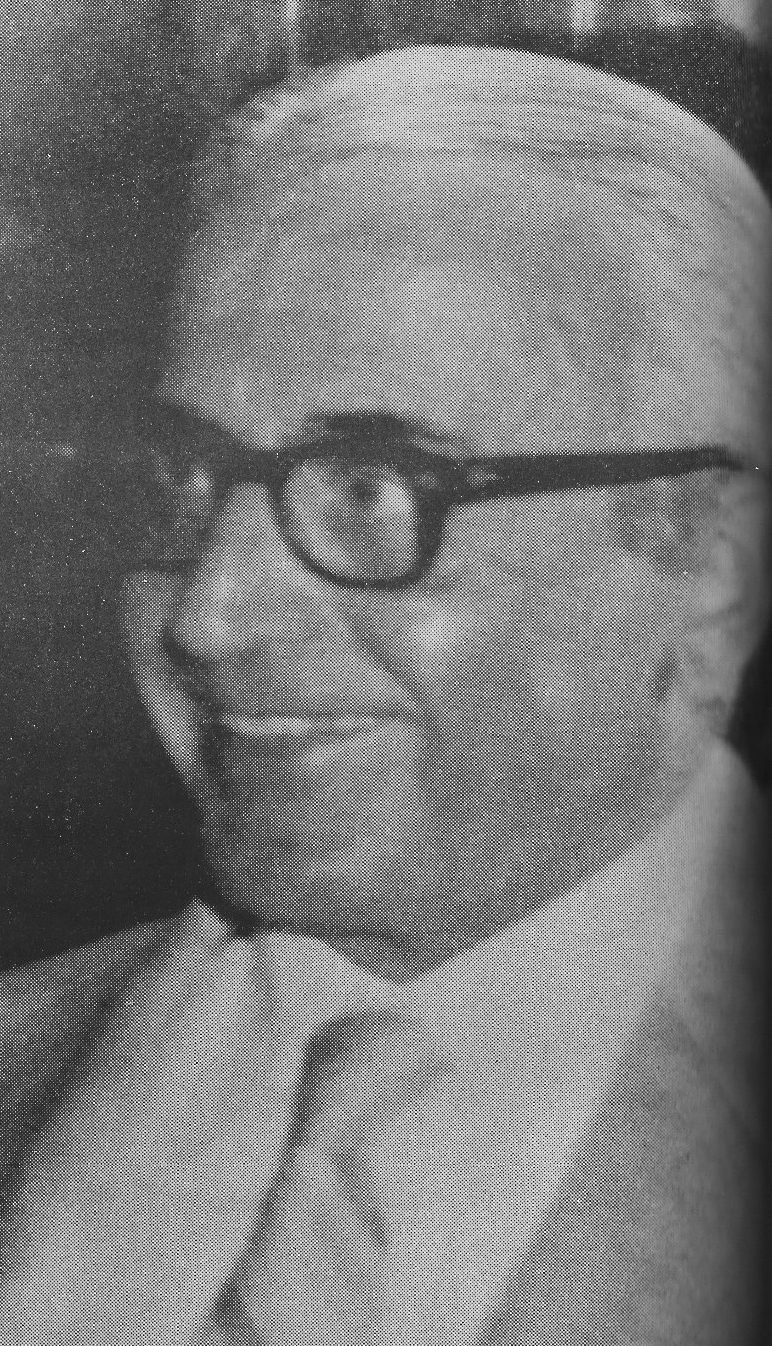
Father John A. Limberakis and Dr. Anthony G. Borden.
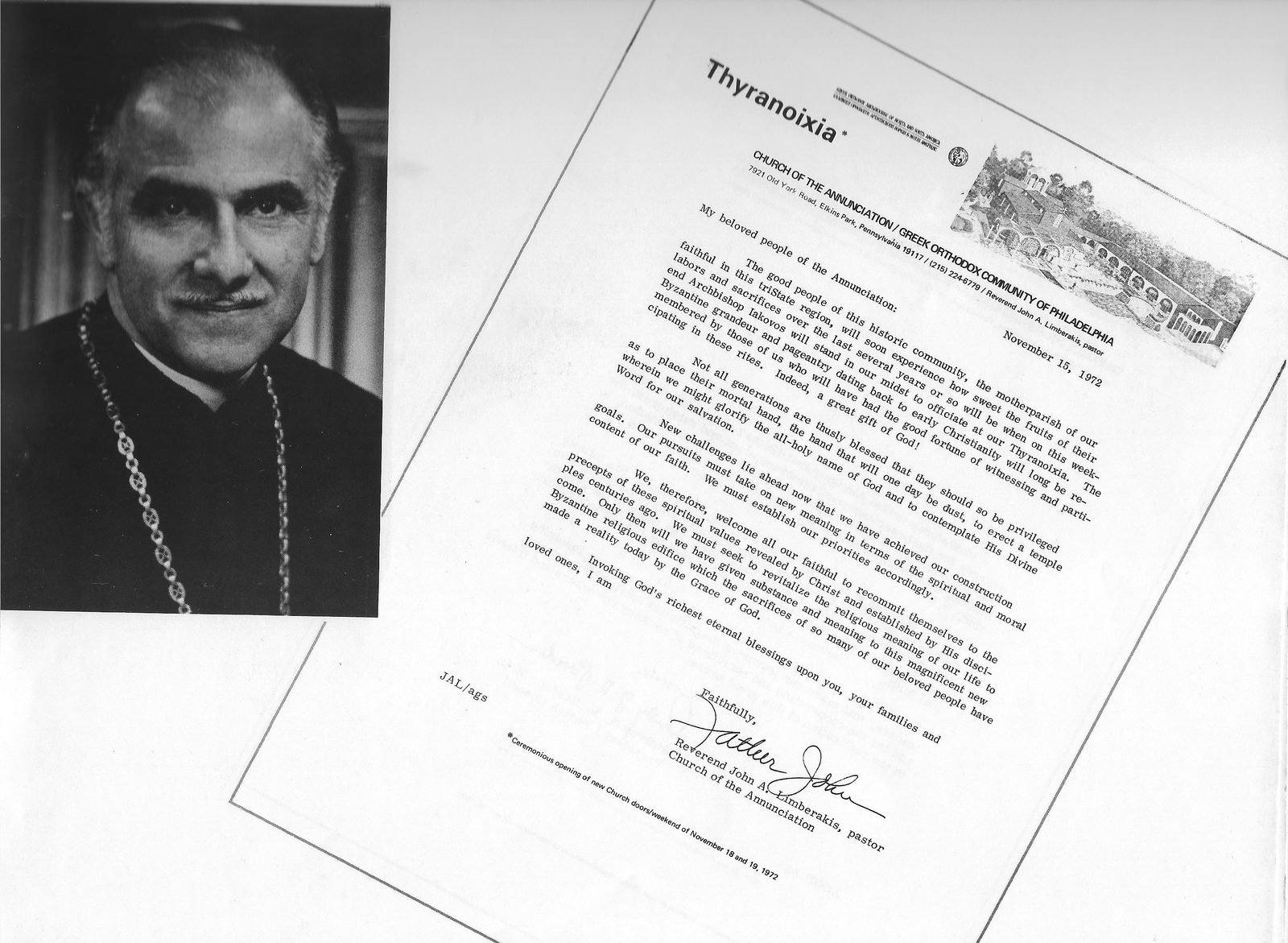
No two people in the parish's history did more to get this complex built than its pastor and its Parish Council President. Father John A. Limberakis was the dynamic priest whose pastorate here spanned the purchase of the Elkins Park land, the construction of the cultural center and the church, and the Thyranoixia that opened its doors. Dr. Anthony G. Borden, a World War II veteran who had promised the Panagia he would build her a church if he survived defending his native Greece from the Nazis, led the Parish Council through the fundraising appeals that convinced a working-class parish to build anyway — and returned, decades later as a widower's family legacy, to see the church he promised consecrated.
The record
The paper trail behind the story above.
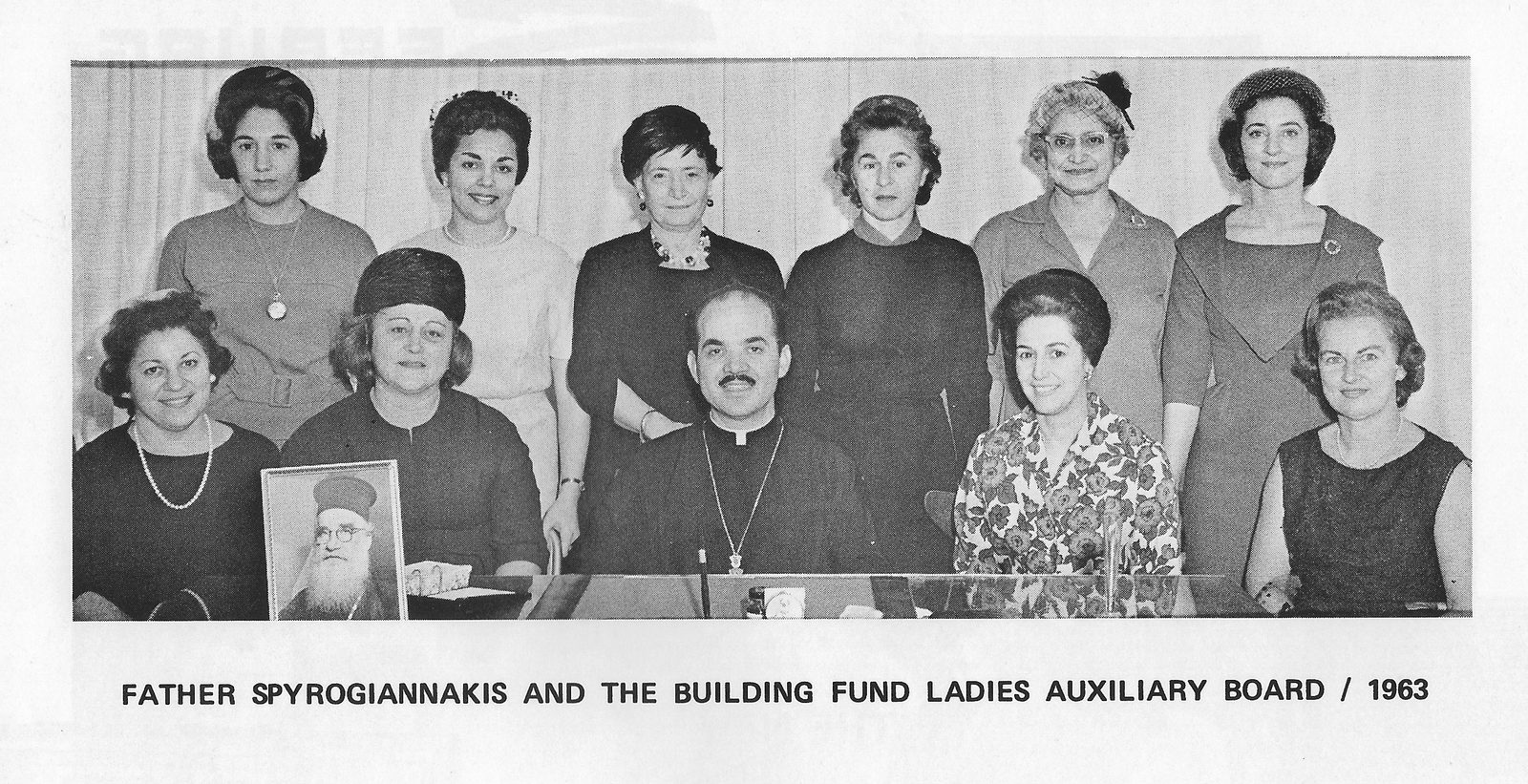
Photographs and letters the parish has kept across a century and a quarter — the same handful of families and the same buildings, doing this work again and again.
In their own words, 1968
Two letters, written before a single wall stood.
The parish that wrote these words had nothing built yet either — no cultural center, no sanctuary of its own design, only a converted Episcopal church and a plan. What follows is the appeal that convinced them to build anyway, in very nearly the words this year's campaign is using again.
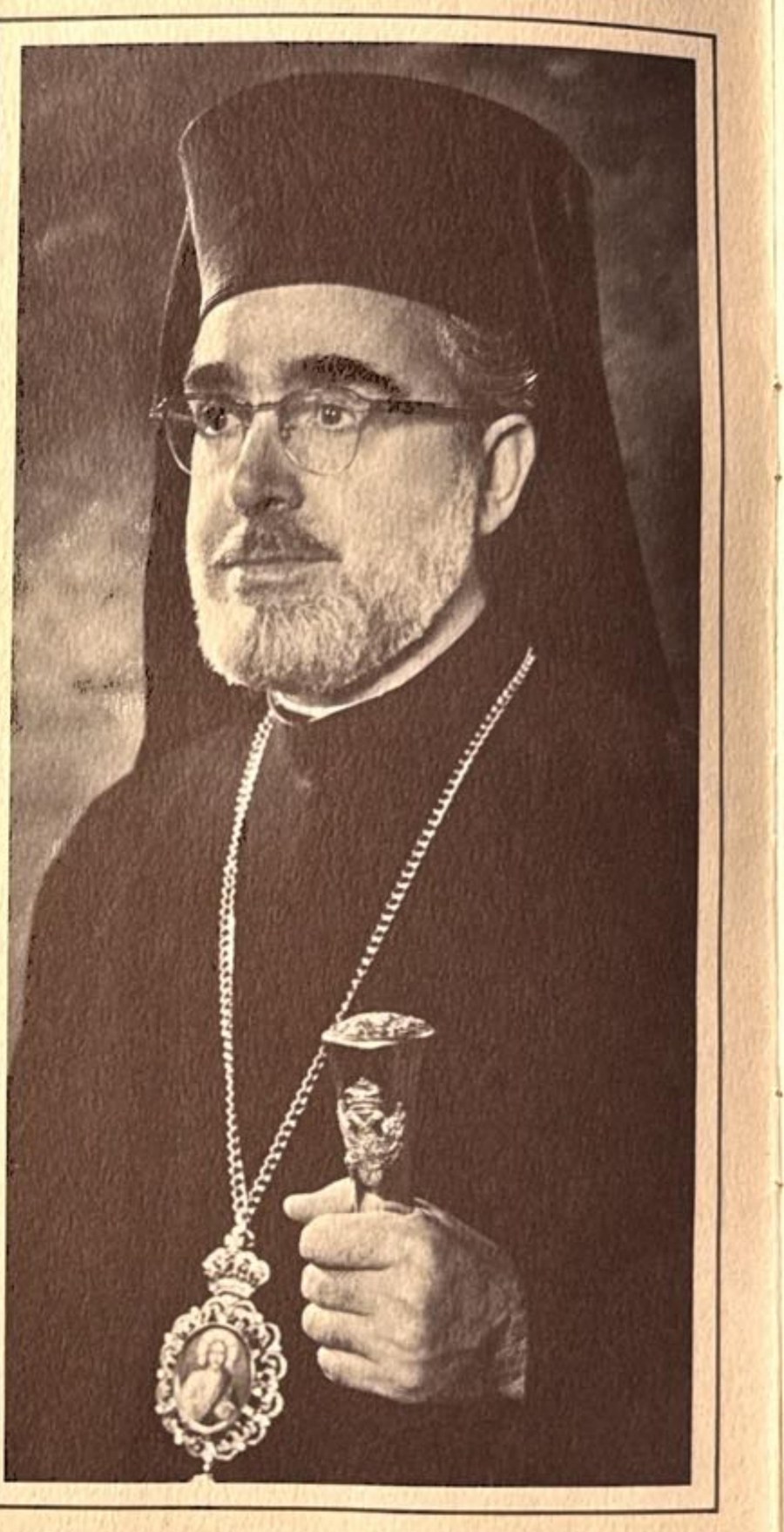
“A Greek Orthodox church is not only a place of divine worship and sanctification through the saving grace of the Holy Sacraments, but is at the same time the hearth of our national and religious traditions and our Greek Orthodox ideals — illuminating and warming us, and inspiring their transmission to the generations to come.”
Archbishop Iakovos of North and South America, in a letter to the parish upon the laying of the cornerstone, May 16, 1968 — translated from the Greek.
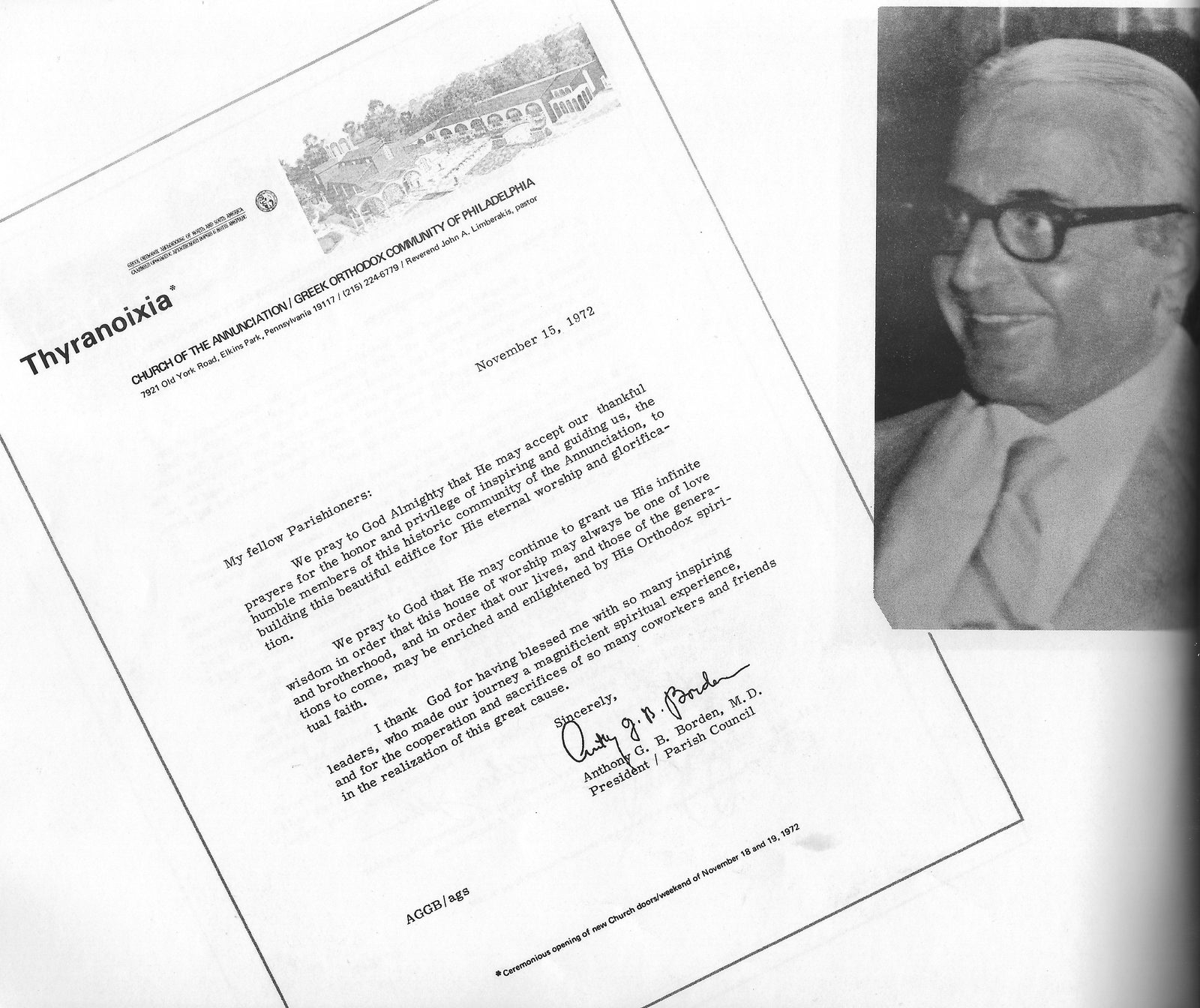
“With pride and dedication we are embarking on a great religious and cultural project that will properly place our new Byzantine Church and educational facilities among other major faiths. The entire community will be proud of this monumental creation which will provide religious and moral guidance for our children and adults. We have accepted the responsibility for this project with deep faith in God and the sincere belief that the cause is right. It is indeed an honor as well as a challenge to undertake the creation of a truly Byzantine Church, school and auditorium, so necessary for the survival of our parish and worship of God. Only with selfless generosity and brotherly love and unity will we be able to continue our faith and pass on our glorious heritage and ideals to our children. Let us make the maximum sacrifice for a worthy cause. Let us be the new founders in this rebirth of our beloved community.”
Dr. Anthony G. Borden, President of the Parish Council, and Constantine Stephano, Chairman of the Building Committee, in the 1968 capital campaign brochure.
Four years later, when the doors opened
They wrote again.
On November 15, 1972, three days before the Thyranoixia, Dr. Borden and Father John each wrote to the parish they had spent four years building for.
Our need, our policy, our goal
“At least ten percent (10%) of one year’s income, or one percent (1%) of family net worth, whichever amount is greater — payable over a period not to exceed three years (June, 1968 through June, 1971), to cover four income tax periods. The Bible clearly sets forth the tithe, or 10% each and every year. All we ask for the New Building Fund is 10% once, which spread over three years amounts to 3⅓% of yearly income for only three years. It has been about 67 years since we built Annunciation! Is 10% once in 67 years asking too much?”
“The proper and Christian way is: ‘Equal sacrifice but not equal gifts.’ Some are blessed with many riches and high incomes — they should, of course, give more. But the church belongs to all of us, so we should all sacrifice equally. Large donors always have their names in corner stones and memorials — and we welcome and encourage all large donations, the bigger the better — however, all contributions, regardless of amounts, shall be appropriately and gratefully recognized. Hopefully, the widow’s mite, the average parishioner’s pledge, and the rich man’s substance will all harmoniously combine into one united, equal sacrifice, effort. It is not for this committee or anyone to dictate to any of you how much you should or must give toward the success of our New Building Fund Program. That decision is a personal one for each family to make as its love for God and prayerful consideration directs.”
From “Our Need, Our Policy, Our Goal,” the 1968 capital campaign brochure — the same standard behind this campaign’s own giving guideline today.